
A Threads user posting as @siti.anisahj shared pictures of crowded platforms at the Gombak and Taipan LRT stations and tagged the Prime Minister.
“Assalamualaikum @anwaribrahim_my. Can we ask for a few more train coaches? It is like this every day. Driving means getting stuck in traffic, while taking the train means facing overcrowding,” she wrote, as quoted by FMT and NST.
Datuk Seri Anwar Ibrahim replied, and that’s when it became news.
What Anwar said
Anwar tagged Rapid KL, the Transport Ministry and Transport Minister Anthony Loke in his reply.
“Wassalam. I urge @myrapidkl, @ministryoftransportmy and @lokesiewfook to take note of this problem and find an immediate solution,” he wrote, according to The Star. “This happens frequently and certainly disrupts the daily routines of the people. We must be more attentive and take action.”
People noticed. The Star reports his reply had about 50,000 likes, more than 494 comments and about 2,900 reposts by 12.10pm on Friday.
So the request is clear. The question is what “immediate” can actually mean on this particular line.
Why it’s mostly the Kelana Jaya Line
Both stations in the photos sit on the Kelana Jaya Line, and that line is where the pressure is.
It’s the busiest LRT line in the Klang Valley, carrying about 290,000 passengers a day, according to Prasarana figures reported by The Star and NST. And it’s been having a rough year.
Earlier this month, Prasarana acting president and group chief executive Dr Prodyut Dutt told Bernama the line had recorded one incident for every 749km travelled between January and August 2026, compared with one for every 1,066km over the same period in 2025.
“There is no denying the fact that we are having more incidents in 2026 than we had last year. On the Kelana Jaya Line, that represents a deterioration of about 30%,” he said.
That’s a reversal of a trend that had been heading the right way. Malaysiakini notes Loke said in January that disruptions on Prasarana-operated rail fell from 118 cases in 2023 to 71 in 2024 and 31 in 2025.
What keeps going wrong
According to Dutt, 90% of the line’s disruptions come from rolling stock, meaning the trains themselves. Two-thirds are triggered by the automated emergency braking system, which kicks in when wheel-speed sensors called tachometers detect a discrepancy above 5%.
The line runs 74 trains across three generations, including 26 first-generation four-car sets that have been in service for more than 17 years. Replacement tachometers can take eight to 12 months to arrive.
“Cost is not the issue because the government has been very supportive,” Dutt said. “Our main challenge is the lead time for spare parts.”
The hard part: the new trains
Here’s the catch. The real fix is already ordered, and it isn’t coming soon.
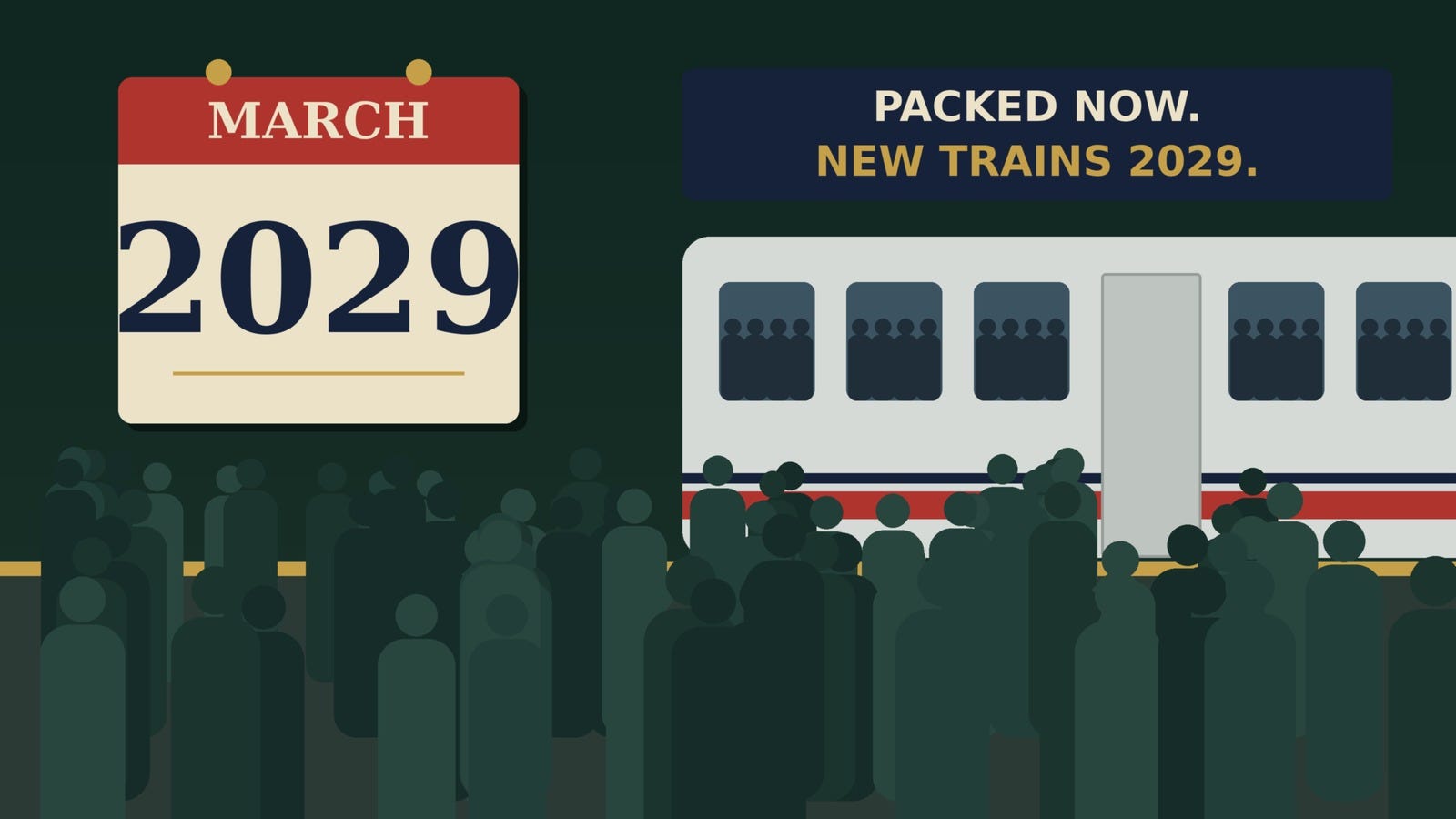
Prasarana has ordered 26 new train sets worth more than RM1 billion from Chinese manufacturer CRRC. The first are scheduled to arrive in March 2029, with two sets a month after that.
That timeline has slipped. In February, Loke said the 26 trains were expected by 2028, The Star reported.
So when the Prime Minister asks for an immediate solution, the honest answer is that the big one is more than two years out. Everything in between is about squeezing more reliability out of what’s already on the tracks.
What can happen in the meantime
Prasarana has already listed its interim measures. They include 24-hour maintenance across depots and workshops, turning trains back at selected stations to ease congestion, isolating affected track sections, shuttle services, feeder buses, WhatsApp alerts for registered users and more auxiliary police, station officers and Prasarana Troopers on platforms to manage crowds.
A major overhaul of the bogies on the line’s nine-year-old third-generation trains is due to start in June or July next year.
None of that adds a carriage to a full train tonight. What it can do is cut the breakdowns that turn a busy platform into a packed one.
It’s not only one line, either. NST reports crowding at Bukit Bintang on the Kajang MRT Line on 8 October lasted about three hours.
What to watch
The first thing is a response from Loke or Rapid KL with specifics: more trains at peak hour, a revised timetable, or a clearer plan for Gombak and Taipan.
The second is whether this becomes a pattern. Commuters have now seen that a viral post can get the Prime Minister’s attention. The harder test is whether the line gets better on days when nobody is posting about it.
Sources
Anwar directs Loke, Rapid KL to resolve train congestion, FMT
Prompt action ordered on train overcrowding following commuter’s social media plea, The Star
[UPDATED] Anwar directs Loke, Rapid KL to resolve recurring train congestion, NST
PM directs Rapid KL, MOT to promptly tackle worsening train overcrowding, Malaysiakini
Anwar tells Transport Ministry, Rapid KL to act on train overcrowding complaints, Malay Mail
Prasarana ramping up efforts to improve LRT reliability after challenging 2026, The Star (Bernama)
Prasarana ramps up efforts to improve LRT reliability, NST (Bernama)
26 new train sets for Kelana Jaya LRT expected in 2028, says Loke, The Star